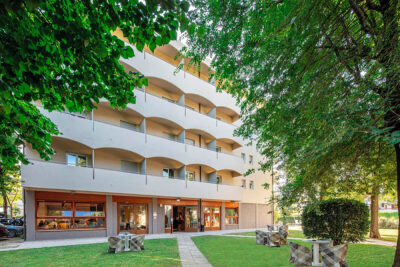
Inside the “Hotel La Pergola” Project
A CAP Arreghini Case Study di CAP Arreghini
From theory to practice. We have already highlighted the importance of the application system and its central role within facade refurbishment projects: a solution that goes beyond the product itself in terms of reliability, durability and overall performance.
To fully understand its advantages, application methods and results in a real-world context, it is useful to analyse a concrete example. The Case Study of Hotel La Pergola – Lignano Sabbiadoro offers insight into a facade refurbishment project developed in collaboration with the designer, highlighting both the technical approach adopted and the improvements achieved.
CAP Arreghini played an active role as technical partner and supplier in the refurbishment of this hospitality property located in a coastal area.
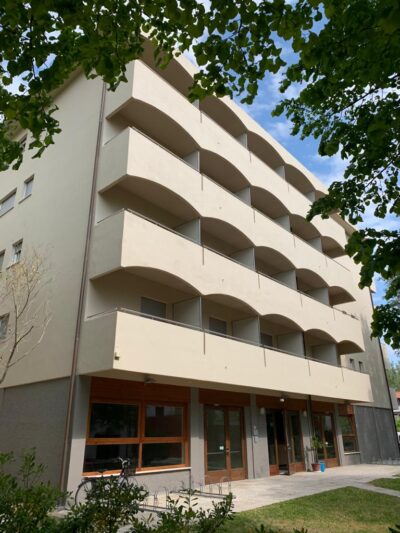
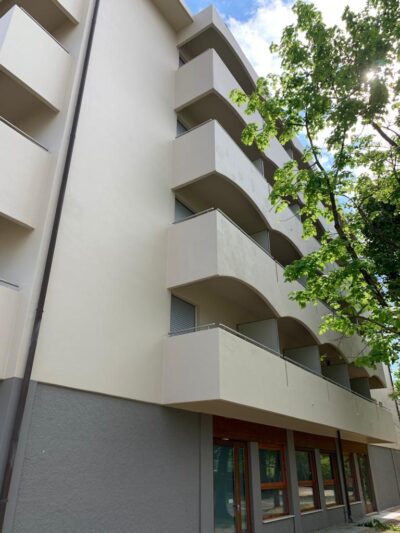
Deterioration of the facades was not solely caused by ageing or delayed maintenance, but was also influenced by the building’s north-west exposure, which made the surfaces particularly vulnerable to humidity, airborne pollutants and biological growth.
Following a detailed technical assessment, the facades underwent a comprehensive restoration programme. With the aim of restoring the original aesthetic quality of the walls while enhancing their long-term durability, the client sought to minimise future maintenance requirements.
Analysis as the first step
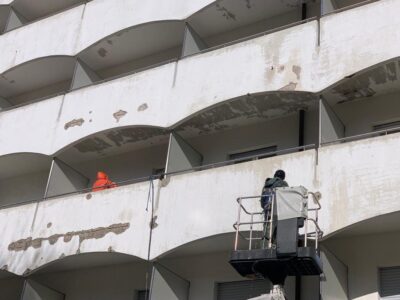
Every intervention begins with a careful assessment of the existing conditions. The same methodology was applied to the Hotel La Pergola project in Lignano Sabbiadoro, where widespread deterioration of the existing facade finish was identified, including algae and mould contamination across multiple areas, surface microcracking and uneven substrate absorption.
Once the level of deterioration had been established, the next step was to identify the critical issues to address and define the long-term performance requirements. Working in close collaboration with both the designer and the applicator contractor, CAP Arreghini identified the most suitable application system to meet the project requirements.
As previously highlighted, the selection of a coating system is never universal: it depends on substrate conditions, environmental exposure and the specific performance objectives of the project. Through this process, the company was able to develop a shared technical solution, reducing the risk of application issues during the execution phase.
The intervention as the core of the project
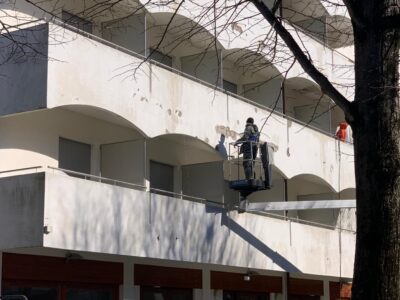
Following the analysis and the definition of the coating cycle, the project moved into its operational phase. The intervention was developed through a complete multi-stage system, beginning with cleaning and substrate preparation. Loose and compromised sections of the facade were removed, while surfaces affected by algae and mould were treated in order to restore their integrity. A dedicated primer coat, Murisol, a solvent-based pigmented primer, was then applied to consolidate and even out the substrate, regulate absorption and improve adhesion for the subsequent layers.
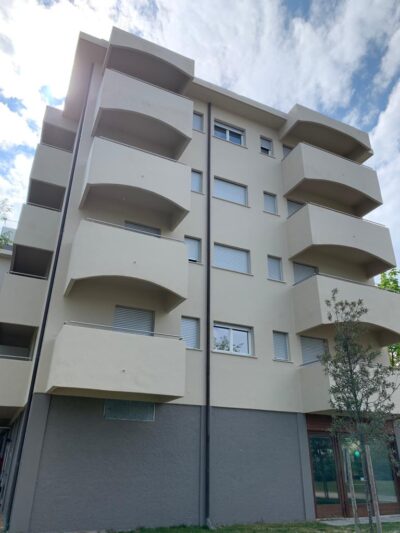
The final stage involved the application of the protective finish. An elastic siloxane-based system was selected, using multiple coats of Sil 2000 Active with anti-mould and anti-algae additives. Thanks to its water-repellent yet breathable properties, the system protects the facades from water ingress while allowing water vapour to escape. This solution proved particularly suitable for addressing the challenges related to the building’s exposure and environmental conditions.
Siloxane systems
Siloxane coatings represent an advanced solution capable of delivering extremely high performance levels. Their dual action — water repellency combined with breathability — allows masonry surfaces to remain dry and protected even under aggressive climatic conditions, including frequent rainfall and freeze-thaw cycles.
This performance is made possible by their particular molecular structure, which creates a microscopic network capable of repelling water, dust and atmospheric dirt. At the same time, the microporous structure allows moisture vapour to escape, helping maintain the substrate in optimal condition. Suitable for both new and existing substrates, CAP Arreghini siloxane coatings ensure long-term surface quality while preserving colour stability against sunlight and UV exposure.
High-Performance solutions
CAP Arreghini’s ability to interpret project requirements and support the intervention efficiently also emerged clearly throughout the Hotel La Pergola refurbishment.
During the works, as often happens in refurbishment projects, additional issues related to substrate inconsistency and heavily deteriorated areas became evident. CAP Arreghini supported the applicator contractor by providing technical expertise and long-standing know-how developed through years of experience in facade systems.
Several key measures were implemented during the intervention, including localised reinforcement of critical substrate areas, careful management of drying times between the different application phases and constant monitoring of climatic conditions during installation.
These elements, often underestimated, proved essential in ensuring both the aesthetic quality and long-term performance of the final result.
Following the intervention, the facades regained visual uniformity and aesthetic quality. Restored and protected, the surfaces now offer improved resistance to dirt, weathering and biological growth.
Consolidated & technical know-how
The Hotel La Pergola project in Lignano Sabbiadoro demonstrates CAP Arreghini’s ability to support complex refurbishment and construction projects with effectiveness and reliability. The value provided goes beyond product quality alone and is rooted in deep technical expertise and application know-how.
Through this approach, the company supports the specific design and site requirements of each project while also contributing to better medium- and long-term cost management.
Thanks to the correct organisation of the operational phases and the clear definition of the application system, CAP Arreghini supported the applicator contractor in meeting the planned schedule, contributing to the continuity and efficiency of the intervention throughout every stage of the works, in line with the original planning.
Equally important from an economic perspective, the adoption of a complete coating system helped optimize the overall cost over the medium to long term by reducing the need for future maintenance interventions.
CAP Arreghini’s consolidated know-how enables the company to identify critical issues and translate them into coherent and reliable application systems. In a market increasingly focused on quality, durability and long-term performance, CAP Arreghini stands out through a value that extends beyond the product itself, expressed through technical consultancy and the ability to develop integrated solutions capable of ensuring optimal results over time.